Table of Contents
- What Affects Leather Seat Repair Cost
- Types of Leather Damage and Repair Complexity
- Car Leather Seat Restoration Cost: Localised Repair vs Full Recolouring
- Mobile vs Workshop Repair Services
- DIY vs Professional Leather Car Seat Repair
- How to Clean Stained Car Leather Seats
- Repair Longevity and Warranty Expectations
- Getting a Quote and Next Steps
- Frequently Asked Questions
Last Updated: September 21, 2026
What Affects Leather Seat Repair Cost
The cost of leather seat repair depends on several interconnected factors that determine whether you’re looking at a straightforward fix or a more involved restoration. Understanding what drives pricing helps you budget realistically and avoid surprises when you get a quote.
Damage severity is the primary cost driver. A small scuff on a single seat costs far less than a tear spanning multiple sections or heat damage across an entire row. The type of leather matters too, genuine leather, bonded leather, and vinyl each require different repair approaches and materials. Colour matching complexity adds another layer: matching a factory finish on a luxury car is more intricate than working with a standard colour on a mainstream vehicle.
The repair method you choose significantly impacts the final bill. Localised repair, where a technician addresses only the damaged area, costs considerably less than full recolouring, which involves treating an entire seat or seating section. Your vehicle’s age and leather condition also factor in, older leather that’s already faded or conditioned differently requires more prep work before repair can begin.
Labour accessibility affects pricing as well. Mobile technicians who visit your home or workplace typically charge differently than workshop-based services, partly because they’re eliminating your downtime and travel. The technician’s expertise level and your location within the service area also influence the final cost.
Types of Leather Damage and Repair Complexity
Scuffs and surface abrasion
Scuffs represent the most straightforward leather damage to repair. These surface-level marks occur when friction or contact scratches the topcoat without penetrating deeper into the leather grain itself. They’re common on high-touch areas like armrests and seat edges where hands and clothing make repeated contact.
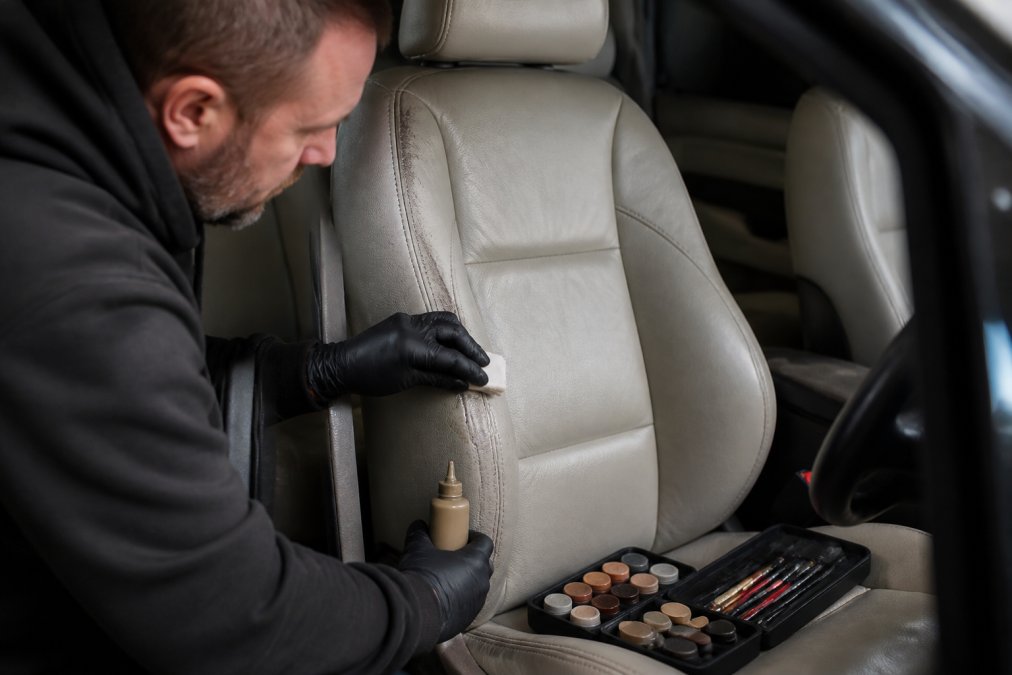
Repairing scuffs typically involves cleaning the area thoroughly, lightly sanding if necessary, and reapplying a protective topcoat or dye to restore the original appearance. The repair complexity remains low because the underlying leather structure is intact. Most scuff repairs are completed within a single appointment and require minimal drying time.
Cracks and cracking leather
Cracks represent a more serious form of damage that penetrates the leather’s surface layer. They develop from age, exposure to heat and sunlight, or simply from the leather drying out over time. Unlike scuffs, cracks compromise the structural integrity of the material and create pathways for moisture and dirt to penetrate deeper.
Repairing cracked leather involves cleaning out the crack, applying a flexible filler compound to restore the leather’s structure, and then colour matching the repair. For extensive cracking across a large area, the technician may recommend full recolouring of the seat to ensure a consistent appearance. The repair complexity increases significantly because the technician must address not just the surface but also the underlying damage.
Tears and stitching damage
Tears are among the most visible forms of leather damage and often the most concerning to car owners. A tear that severs the leather material requires stitching or patching to restore structural integrity. Stitching damage, where the thread holding the leather together has come loose, creates a similar problem.
Repairing tears depends on their size and location. Small tears (under 2 centimetres) can sometimes be glued and sealed. Larger tears typically require stitching or a patch applied to the underside of the leather. If the tear is in a high-stress area like a seat edge, the repair becomes more complex because it must withstand repeated movement and pressure.
Heat damage and sun fading
Heat damage occurs when leather is exposed to extreme temperatures, often from cigarette burns, hot objects, or direct sunlight. Sun fading gradually lightens leather colour over months or years of exposure, particularly on the driver’s side of the vehicle. Both types of damage affect the leather’s appearance and can compromise its protective topcoat.
Cigarette burns create a specific type of heat damage where the leather is charred or melted. Depending on the depth, the burn may be cleanable with surface treatment or may require the damaged area to be sanded and refinished. Sun fading typically requires full recolouring of the affected seat to restore a uniform appearance, as spot repairs on faded leather are often noticeable.
Car Leather Seat Restoration Cost: Localised Repair vs Full Recolouring
Localised repair addresses only the damaged area, making it the more economical choice for isolated damage. A single scuff, small tear, or localised burn is treated independently without affecting the surrounding leather. This approach preserves the original finish in undamaged areas and minimises labour time.
Full recolouring involves treating an entire seat or seating section with new dye and topcoat. This approach is necessary when damage is extensive, when multiple areas are affected, or when sun fading or colour variation makes localised repair impractical. Full recolouring ensures a uniform appearance across the entire seat but requires significantly more labour and material.
The choice between the two depends on damage severity and pattern. A single tear in one location calls for localised repair. Scattered scuffs across multiple areas, or fading that affects the entire driver’s seat, may justify full recolouring. Professional technicians assess the damage and recommend the approach that delivers the best value and appearance.
| Repair Approach | Best For | Complexity | Drying Time |
|---|---|---|---|
| Localised repair | Single scuffs, small tears, isolated burns | Low to medium | 2-4 hours |
| Full recolouring | Extensive damage, sun fading, multiple areas | Medium to high | 4-8 hours |
Mobile vs Workshop Repair Services
Mobile leather seat repair technicians travel to your location, typically your home, workplace, or a convenient location, to perform repairs on-site. This approach eliminates the need to drop your vehicle at a workshop and wait for collection, which is particularly valuable for busy professionals and fleet operators.
Mobile services typically charge a call-out fee in addition to labour costs, but the convenience often justifies the additional expense. The technician arrives with equipment and materials, assesses the damage in person, and can often complete repairs the same day. For lease vehicle holders facing end-of-lease inspections, the speed and convenience of mobile repair is a significant advantage.
Workshop-based services operate from a fixed location where you drop off your vehicle. This approach may offer lower hourly rates in some cases, but you’re responsible for transport and you’re without your vehicle during the repair period. Workshops may also handle more extensive restoration work that requires specialised equipment.
The choice between mobile and workshop services depends on your priorities. If convenience and speed are paramount, mobile services justify their premium. If cost is the primary concern and you can spare your vehicle for a day or two, workshop services may offer better value.
DIY vs Professional Leather Car Seat Repair
DIY repair kits are available for basic damage like scuffs and minor discolouration. These kits typically include cleaning solution, colour-matched dye, and applicators. They appeal to budget-conscious owners who want to avoid professional service costs.
However, DIY repairs carry significant risks. Colour matching is notoriously difficult without professional equipment and experience, a mismatched repair is often more noticeable than the original damage. Applying filler or dye unevenly can create blotchy patches or texture inconsistencies. Once a DIY repair goes wrong, correcting it often costs more than professional repair would have from the start.
Professional leather seat repair offers several advantages. Technicians have years of experience assessing damage and selecting the appropriate repair method. They use professional-grade materials and colour-matching equipment that produces results matching factory finishes. They also understand leather conditioning and can advise on maintenance to prevent future damage.
For anything beyond minor surface marks, professional repair is the safer choice. The cost difference is often smaller than owners expect, particularly when you factor in the risk of a failed DIY attempt requiring professional correction.
How to Clean Stained Car Leather Seats
Staining is one of the most common leather problems and often the easiest to address before it becomes permanent. The key is acting quickly, the longer a stain sits, the more likely it is to penetrate the leather’s protective topcoat.
For fresh spills, blot immediately with a clean, dry cloth. Don’t rub, as this works the liquid deeper into the leather. Once you’ve removed excess moisture, assess the stain type. Water-based stains (coffee, juice, soft drinks) usually respond to gentle cleaning with a slightly damp cloth. Oil-based stains (grease, sunscreen) require specialised leather cleaners.
Apply a leather-specific cleaner according to product instructions, most are sprayed onto a cloth rather than directly onto the leather.
Repair Longevity and Warranty Expectations
A well-executed professional leather repair typically lasts several years. The longevity depends on the repair type, the quality of materials used, and how the repaired area is treated post-repair.
Getting a Quote and Next Steps
The most reliable way to get an accurate quote is to contact a professional service directly. Many repairers, including mobile technicians, accept photos of the damage and can provide preliminary quotes based on images. This approach costs nothing and helps you compare options without committing to anything.
Frequently Asked Questions
How much does it cost to repair a leather car seat in the UK?
Leather seat repair costs vary significantly based on damage severity, seat size, and repair type. Localised repairs for scuffs or small tears typically cost less than full recolouring or stitching repairs. Mobile leather seat repair cost depends on whether you need surface cleaning, topcoat application, filler compound work, or full leather restoration. Contact TrimKings for a no-obligation quote based on photos of your specific damage.
Can a ripped leather car seat be repaired professionally?
Yes. Professional technicians can repair tears. The repair quality depends on tear size, location, and leather type. Mobile technicians can assess your seat and provide a realistic estimate of repair durability.
Is it cheaper to reupholster car seats or buy new ones?
Repairs can be a cost-effective alternative to replacement seats. For lease vehicles, repairs also help avoid end-of-lease penalty charges. Compare repair costs against replacement costs by getting a quote from a mobile technician who can assess your specific damage.
How long does mobile leather seat repair take?
Mobile service duration depends on repair complexity. Mobile technicians work at your home or workplace, eliminating travel time and allowing you to use your vehicle the same day in many cases. Turnaround time varies by damage type and leather conditioning requirements. Ask your technician for an estimated completion time when you receive your quote.